
Economics exams punish fuzzy definitions. Generic cram packs are not the slides your lecturer posted — for example in a Corvinus or ELTE GTK course, or any other faculty. (Those names are audience examples only, not partners or endorsements.) You need cards for this term’s models and the “do not confuse A with B” pairs your lecturer stressed.
This workflow works with paper cards. ScienceIQ builds the first deck from the upload so you spend time rating cards, not typing them.
Card templates that survive an econ oral or written
Use three templates only:
| Front | Back |
|---|---|
| Define X in one sentence (course wording) | Exact definition + one classroom example |
| When do you use model M vs model N? | Trigger conditions + one graph cue |
| What shifts curve C, and which way? | Shifters list + “held constant” list |
Skip essay-length backs. If you cannot say the back aloud in twenty seconds, cut it.
Worked example: three cards from one micro lecture
Paraphrased slides on price ceilings:
A binding price ceiling sits below equilibrium. Shortage appears. Non-price rationing follows. Deadweight loss vs free market.
Cards:
- 1. Front: When is a price ceiling binding? Back: When set below equilibrium price; quantity demanded exceeds quantity supplied.
- 2. Front: Name two non-price rationing methods after a binding ceiling (this lecture). Back: Queues; seller preference / black market (as listed on the slide).
- 3. Front: Binding ceiling vs free market: what happens to total surplus on this graph? Back: Deadweight loss appears; mutually beneficial trades missing.
Quiz yourself on card 1 and 3 the night before; card 2 is the landmine.
A week-of-exam rhythm (adapt to your vizsgaidőszak)
- Day −7 to −4: Generate or write cards from each remaining lecture PDF/PPTX. Rate once.
- Day −3 to −2: Only “hard” and “again” cards + a short quiz on mixed models.
- Day −1: Closed-book: redraw one graph from memory; three definition cards aloud.
- Exam morning: Five landmine cards only.
Hungarian exam periods (typically winter and late spring windows) reward this more than all-night rereading.
Where ScienceIQ fits (and how we differ)
As of October 2026, students hunting for közgazdaságtan vizsga tips and faculty-specific ZH advice often land on generic packs and shared notes. Few AI tools we reviewed start from your slides.
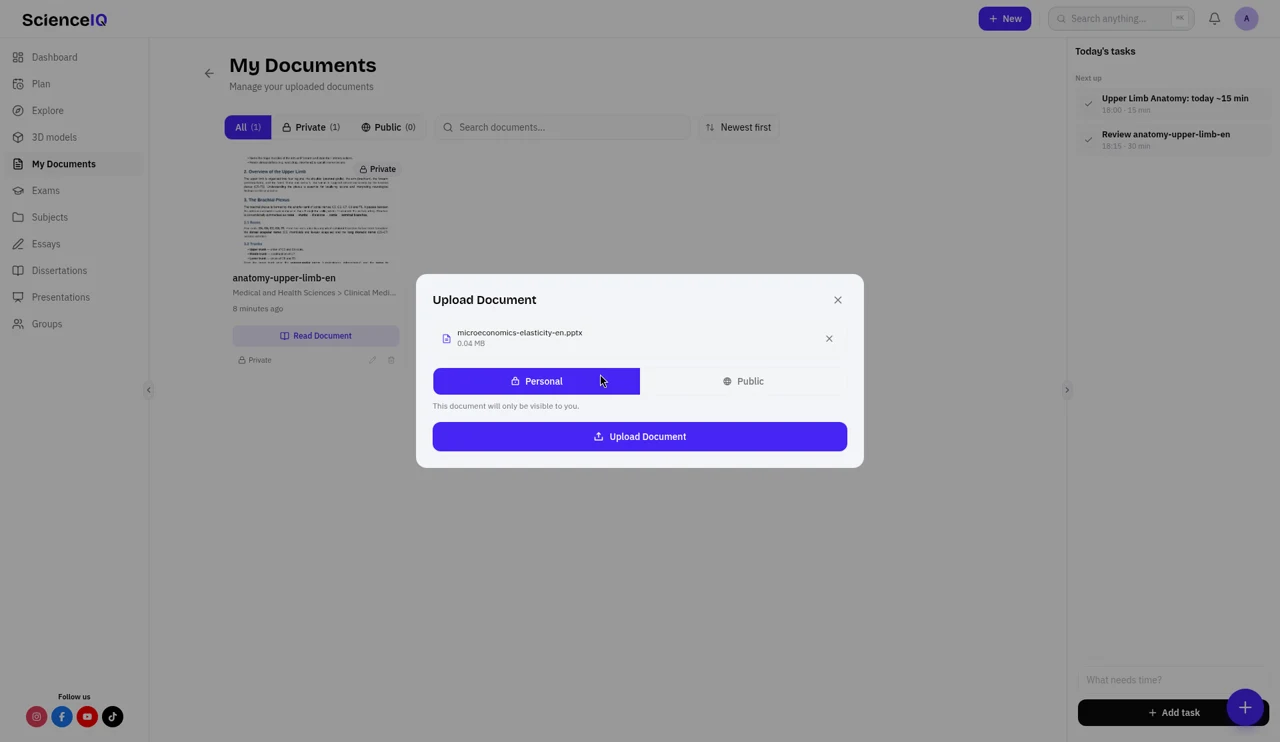
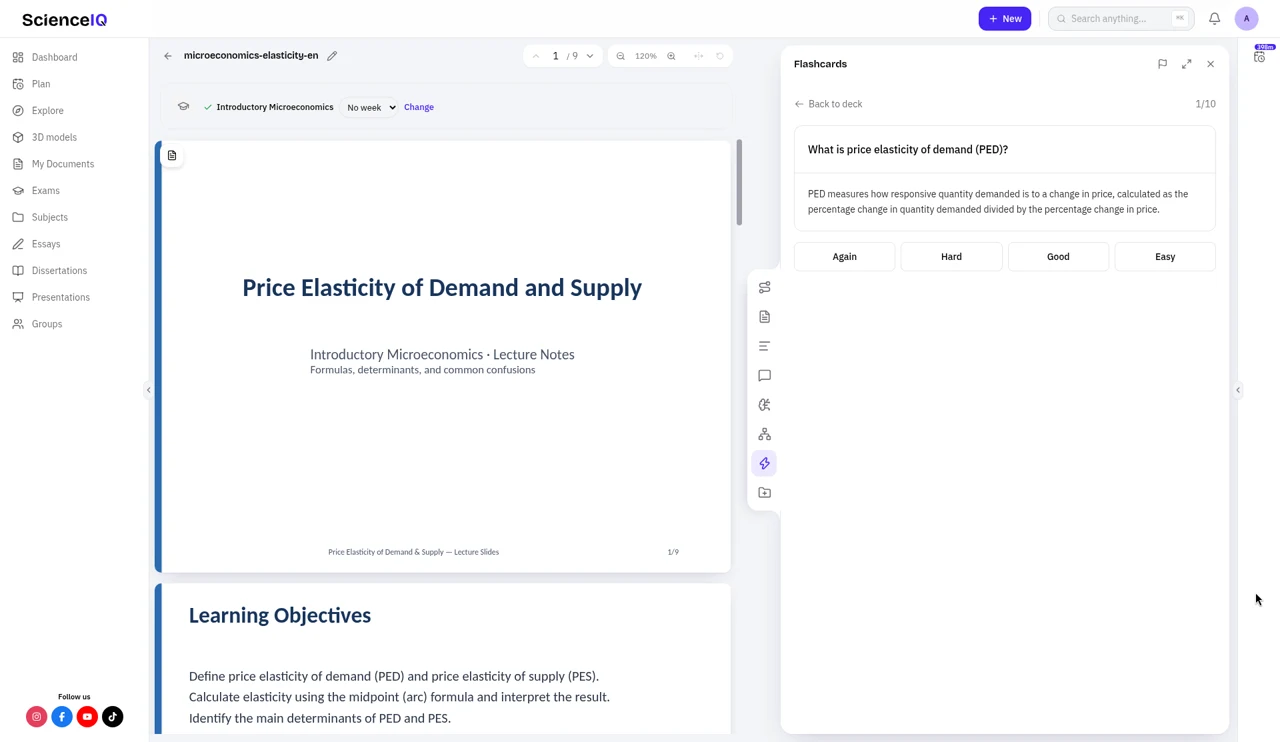
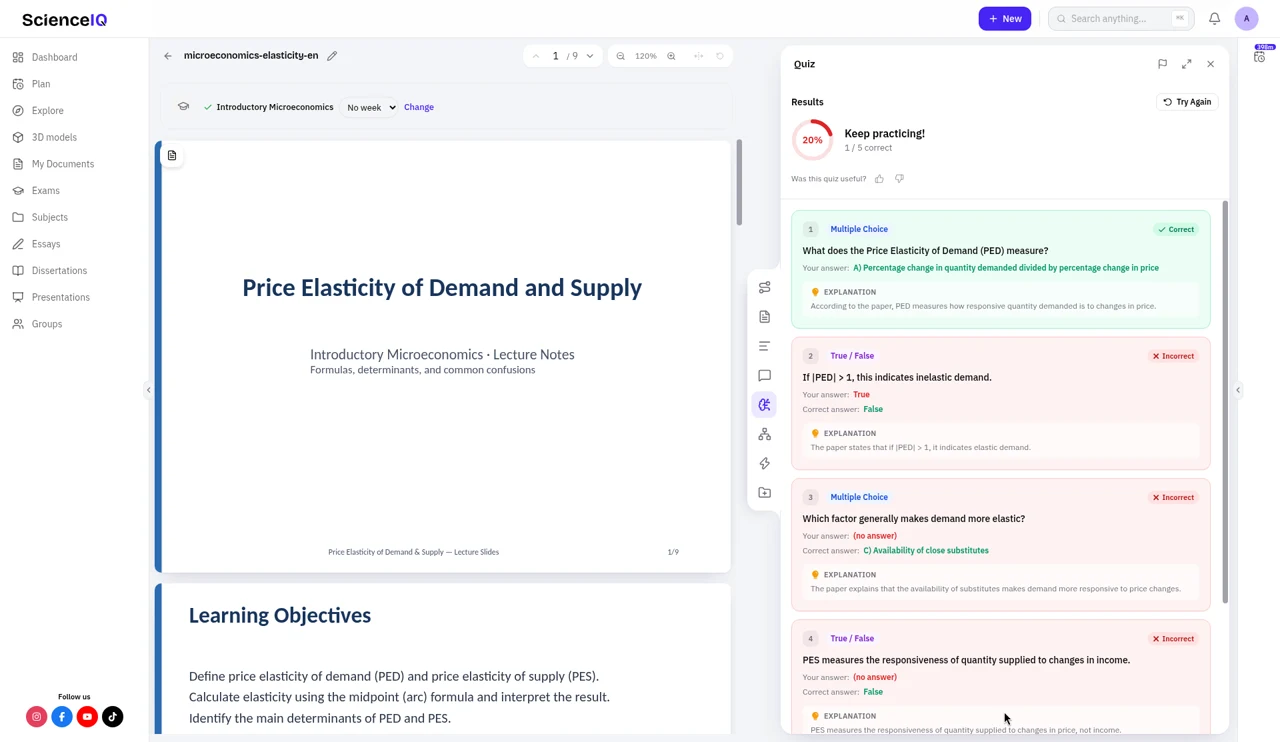
- Upload the lecture PPTX/PDF.
- Build Flashcards, then Quiz, on that file.
- Create a dated Exam and attach the same slides.
- Hungarian UI if you study in HU.
You practise the models your course taught. No grade promise sits on top of that.
Try it on the model you always mix up
Pick the pair you confuse (IS vs LM, ceiling vs floor, short-run vs long-run AS). Three cards. Notes closed tonight.
Try it
Turn your own lecture notes, slides, and documents into summaries, quizzes, and flashcards built from your material, and put the science to work. Try ScienceIQ.
References
- Dunlosky, J., Rawson, K. A., Marsh, E. J., Nathan, M. J., & Willingham, D. T. (2013). Improving Students’ Learning With Effective Learning Techniques: Promising Directions From Cognitive and Educational Psychology. Psychological Science in the Public Interest, 14(1), 4–58.
- Roediger, H. L., & Karpicke, J. D. (2006). Test-Enhanced Learning: Taking Memory Tests Improves Long-Term Retention. Psychological Science, 17(3), 249–255.
Erik Fazakas
Founder of ScienceIQ
Blog
More posts
 Read more
Blog
Med-school anatomy quizzes from your own notes PDF
Anatomy volume is brutal, and generic banks drift from your course PDF. A closed-book quiz loop on the exact lists and diagrams you were given — plus a mind map of systems.
EErik Fazakas • Oct 27, 2026 Read more
Blog
Create a dated exam and attach the PDFs you will be tested on
Study plans stay abstract until the exam date and the exact files live in one place. A concrete setup: one exam object, attached PDFs, then quiz and cards on those files only.
EErik Fazakas • Oct 27, 2026- Read more
Blog
Turn PowerPoint lecture slides into a quiz
Stop retyping Moodle decks into Quizlet. A closed-book quiz workflow from the PPTX your professor posted — plus what to delete before you trust the questions.
EErik Fazakas • Oct 27, 2026