
Students often jump straight into quizzes. Wrong answers pile up, but the shape of the subject stays fuzzy. A mind map from this week’s lecture PDF makes the hierarchy visible before you retrieve.
You can draw the map by hand. ScienceIQ can generate one from an upload so you spend the time testing, not redrawing boxes.
Why structure first, then quiz
Retrieval works best when you know what belongs together. If “supply shocks” and “demand shocks” sit on the same branch as “fiscal multipliers,” your misses tell you which branch to reopen, not just which flashcard.
Buzan’s popular mind-map advice is informal. The learning science that matters here is simpler: organise, then practise testing (Dunlosky et al., 2013; Roediger & Karpicke, 2006).
Worked example: one lecture → map skeleton
Imagine a macroeconomics slide deck titled “IS–LM in the short run” with five section headers:
- 1. Goods market and the IS curve
- 2. Money market and the LM curve
- 3. Joint equilibrium
- 4. Fiscal policy shift
- 5. Monetary policy shift
Hand-drawn (or generated) centre node: IS–LM short run. Five spokes matching those headers. Under “Fiscal policy shift,” add only the three bold terms from the slides (e.g. G↑, crowding-out, liquidity). Stop at one depth unless the exam is tomorrow and that branch is on the topic list.
Rule: map the headings you will be examined on, not every footnote.
A 30-minute structure → quiz loop
- 1. Skim the PDF for H1/H2-style headings (5 min).
- 2. Draw or generate the map; prune anything not on the exam list (10 min).
- 3. Cover the map. Recreate the top level from memory (5 min).
- 4. Run a short closed-book quiz on the weakest branch (10 min).
Tomorrow: quiz first, then reopen only the branches you missed.
Where ScienceIQ fits (and how we differ)
As of October 2026, blank-canvas “how to mind map” tutorials are easy to find. Summary tools (including notebook-style apps) help you read a file; fewer products put a mind map tab on the same lecture document you will quiz from next.
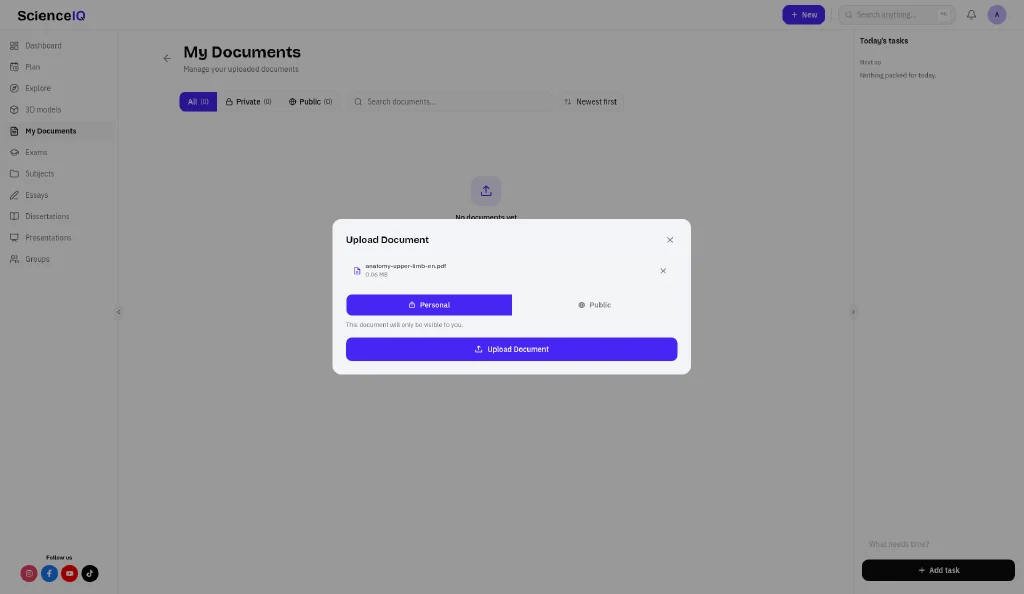
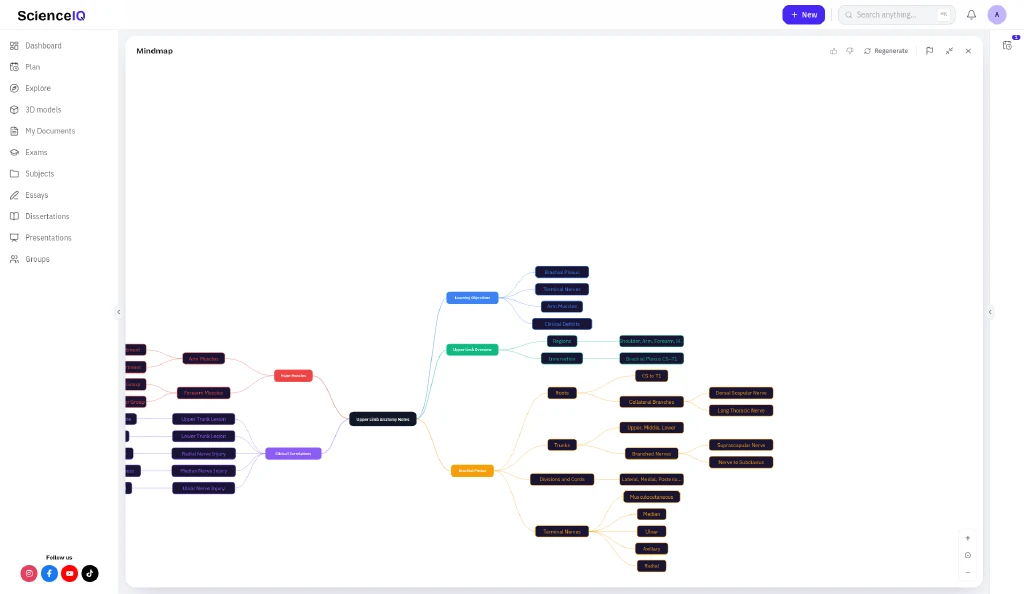
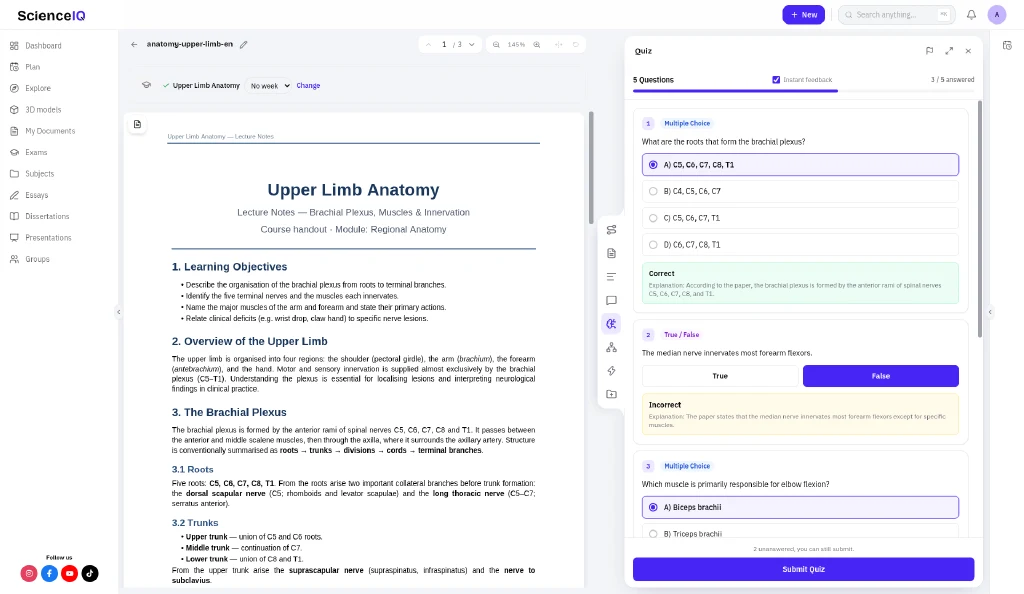
- Upload the lecture PDF (or PPTX).
- Open the Mindmap tab on that document. Structure before speed.
- Switch to Quiz (and Flashcards) on the same file so practice matches the map.
- Optional: attach the file to a dated Exam when the date is set.
Treat the map as a draft of your course outline. Prune it to the topic list your professor actually uses.
Try it on this week’s longest PDF
Map the top-level headings in fifteen minutes. Quiz one weak branch with notes closed. Keep only the branches that match what you will be asked.
Ausprobieren
Verwandle deine Vorlesungsnotizen, Folien und Dokumente in Zusammenfassungen, Quizze und Karteikarten aus deinem eigenen Material, und nutze die Lernforschung. ScienceIQ ausprobieren.
Quellen
- Dunlosky, J., Rawson, K. A., Marsh, E. J., Nathan, M. J., & Willingham, D. T. (2013). Improving Students’ Learning With Effective Learning Techniques: Promising Directions From Cognitive and Educational Psychology. Psychological Science in the Public Interest, 14(1), 4–58.
- Roediger, H. L., & Karpicke, J. D. (2006). Test-Enhanced Learning: Taking Memory Tests Improves Long-Term Retention. Psychological Science, 17(3), 249–255.
Erik Fazakas
Founder of ScienceIQ
Blog
Weitere Beiträge
 Weiterlesen
Blog
Med-school anatomy quizzes from your own notes PDF
Anatomy volume is brutal, and generic banks drift from your course PDF. A closed-book quiz loop on the exact lists and diagrams you were given — plus a mind map of systems.
EErik Fazakas • 27. Okt. 2026- Weiterlesen
Blog
Create a dated exam and attach the PDFs you will be tested on
Study plans stay abstract until the exam date and the exact files live in one place. A concrete setup: one exam object, attached PDFs, then quiz and cards on those files only.
EErik Fazakas • 27. Okt. 2026  Weiterlesen
Blog
Economics exam prep: concept cards from lecture slides
Fuzzy definitions fail econ exams. Build concept and model cards from the slides your professor actually uses — then quiz the pairs you keep mixing up.
EErik Fazakas • 27. Okt. 2026